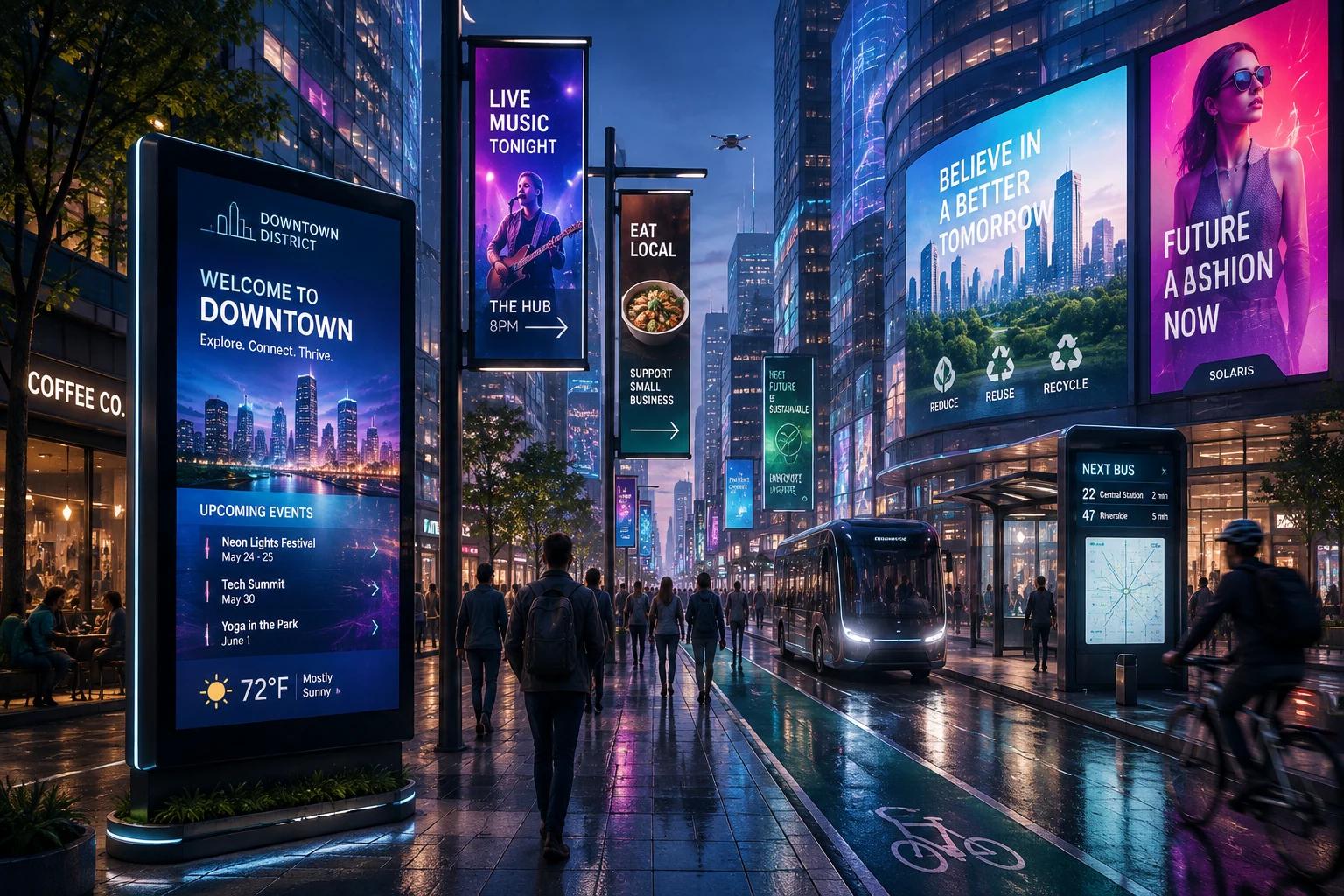
If you read about the future of digital signage, it sounds remarkably futuristic.
Artificial intelligence will decide what content to display. Screens will react to weather, inventory, time of day, audience characteristics, and real-time business data. Digital signage will become interactive, personalized, automated, and deeply integrated with the software organizations already use.
Some of that future is already here.
But there is another side to the digital signage industry that receives considerably less attention:
Most digital signage is still pretty simple.
Businesses create graphics. Someone uploads them. They put those graphics into a playlist. The playlist loops on a television until someone remembers to change it.
Recent research into actual digital signage usage shows just how large the gap is between what's technically possible and how organizations use their screens today.
That gap may be one of the biggest opportunities for the future of digital signage.
Digital Signage Is Growing Quickly
There's little doubt that digital signage will become more common.
Grand View Research estimates that the global digital signage market was worth approximately $31.1 billion in 2025 and projects it will grow to $58.4 billion by 2033, representing an 8.2% compound annual growth rate. Retail represented the largest application segment in 2025.[1]
But market growth doesn't necessarily tell us how those displays are being used.
For that, actual screen data is much more interesting.
Kitcast's State of Digital Signage 2026 report analyzed anonymized telemetry across tens of thousands of screens, a content scan of more than 10,000 screens, hardware reliability data, and responses from 515 digital signage operators.[2]
What they found paints a very different picture from the futuristic digital signage networks often presented at trade shows.
What Businesses Actually Show on Their Screens
Despite years of discussion about dynamic, personalized content, much of today's digital signage is still used for straightforward communication.
According to Kitcast's analysis, weather appears on 79% of screens, making it one of the most widespread types of content. Media and images appear on 76%, while video accounts for a significant portion of actual screen time.[2]
Individual industries are even more revealing.
In retail, for example, 90% of screens show media and 68% show video.[3]
In quick-service restaurants, 82% of screens operate as digital menu boards.[2]
In education, 74% of screens display a live calendar.[2]
These aren't bad uses of digital signage.
They're useful.
A school doesn't always need an AI-powered interactive experience. Sometimes it needs a television in the hallway that says the basketball game starts at 6:00.
A restaurant doesn't necessarily need computer vision analyzing customers. It needs today's menu and prices displayed accurately.
A manufacturing company may simply need production numbers and safety announcements visible to employees.
The disconnect isn't that organizations are using digital signage incorrectly.
It's that the industry's vision for dynamic signage is much further ahead than the way most screens are currently managed.
The Bigger Problem: Digital Signage Isn't Always Very "Dynamic"
One of the most interesting findings from Kitcast's research is how frequently digital signage content actually changes.
The median screen in its dataset displayed content that had last been updated 16.8 days earlier.[2]
The freshest 25% of screens were updated within roughly 2.8 days.
But at the other end of the spectrum, the slowest 25% went more than 94 days between updates.[2]
Even more surprising, 27.7% of scheduled creative was more than one year old.
And 2.5% of screens had effectively become forgotten screens, operating without administrator activity for more than 90 days.[2]
That's an interesting reality for an industry built around the idea of dynamic content.
A lot of digital signage isn't dynamically reacting to the world around it.
It's a digital poster.
And sometimes it's a digital poster nobody has remembered to replace.
Meanwhile, the Industry Is Building Something Very Different
Compare that reality with what the digital signage industry is currently developing.
At InfoComm 2025, the Digital Signage Federation highlighted AI-powered content management systems capable of adapting content based on audience demographics, time of day, and environmental conditions.[4]
Interactive displays, touchless experiences, advanced CMS dashboards, customizable displays, and new display technologies were also prominent.[4]
In other words, the technological direction is clear.
Digital signage is moving toward displays that understand context.
But getting there doesn't necessarily mean every organization needs a wall-sized LED installation packed with cameras and sensors.
The bigger opportunity may be much simpler:
What if the screen just knew what it was supposed to show?
From Playlists to Rules
Most digital signage software today revolves around a concept that hasn't changed very much:
The playlist.
Create some content.
Put it into a playlist.
Assign that playlist to a screen.
Schedule when it should play.
This works extremely well, which is why the model has lasted.
But it also puts the burden of deciding what should be displayed entirely on the person managing the signage.
The next generation of digital signage could begin shifting some of that responsibility toward rules and automation.
Instead of saying:
"Play this playlist from 8:00 AM until 5:00 PM."
A business might say:
"Promote products that are currently in stock."
A restaurant might say:
"Show breakfast items in the morning and stop promoting anything we've sold out of."
A school might say:
"Show today's events, announcements, and lunch menu."
A manufacturing facility might say:
"Show current production numbers, safety alerts, and important employee announcements."
The difference sounds subtle, but it's enormous.
One requires people to continually manage screens.
The other describes an objective and lets the software determine how to accomplish it.
AI's First Job May Be Making Digital Signage Less Annoying
Artificial intelligence is often discussed in digital signage in terms of personalization.
A camera recognizes characteristics about the audience. AI determines which content might be relevant. The advertisement changes accordingly.
That technology certainly has applications.
But it may not be where AI delivers the most immediate value to everyday digital signage users.
Research from the Digital Signage Business Climate Index reported by Invidis found that saving time is currently the main motivation for using AI within the digital signage industry.[5]
Cost reduction followed behind it.
More importantly, AI is currently being applied largely to work that already needed to happen: content creation, software development, and content adaptation.[5]
That's an important distinction.
Before AI transforms what someone sees on a screen, it may transform the amount of work required to keep that screen useful.
Consider the repetitive tasks involved in running even a small digital signage network.
Someone has to create content.
Someone has to upload it.
Someone has to decide where it belongs.
Someone has to schedule it.
Someone has to remember when it becomes outdated.
Someone has to replace it.
And someone has to make sure the display is actually working.
AI and automation could potentially help with almost every step.
Most Digital Signage Operators Aren't Using AI Yet
There's another important reality check.
Despite the attention AI receives within the industry, Kitcast found that only 8.3% of surveyed digital signage operators currently use AI for content.[2]
Nearly half—46.2%—said they planned to use it within a year.
But the most interesting number may be the reason people aren't using it.
Among AI holdouts, 72.8% said they simply didn't see a real need for it.[2]
That's a useful lesson for the digital signage industry.
Customers probably don't need AI because it's AI.
They need software that solves problems.
If AI can automatically turn next week's events into useful signage, that's valuable.
If it can identify outdated content, that's valuable.
If it can build a menu board from existing product information, that's valuable.
If it can tell someone that a screen has stopped working, that's valuable.
The technology matters much less than the work it eliminates.
Integrations May Matter More Than Generative AI
There's another reason automation could dramatically change digital signage.
Organizations already have most of the information they want to display.
It's just somewhere else.
A school's events are already in a calendar.
Its lunch menu may already exist in a spreadsheet or database.
A restaurant's products and prices already exist in its point-of-sale system.
A company's metrics already exist in dashboards.
Employee events are already on calendars.
Marketing assets are already sitting in cloud storage or design tools.
Yet someone often has to take information from those systems and manually recreate it for a screen.
That's unnecessary work.
The future of cloud-based digital signage will increasingly involve connecting those systems directly to displays.
Instead of digital signage becoming another place where organizations create and maintain information, it can become a presentation layer for information that already exists.
Digital Signage Has a Measurement Problem Too
There's another surprising statistic in Kitcast's research.
76.5% of surveyed digital signage operators said they don't measure the ROI of their screens at all.[2]
Only a small minority reported using a concrete method to measure it.
Again, that stands in contrast with the industry's movement toward data-driven signage.
The future of digital signage isn't only about determining what to display. It's also about understanding whether displaying it accomplished anything.
For advertising networks, that could mean impressions and conversions.
For restaurants, it could mean menu engagement or product sales.
For internal communications, it could mean whether important information is reaching employees.
For schools, it may be much simpler: Is the information current? Is the screen online? Are announcements being published when they're supposed to be?
The right measurement depends on the purpose of the screen.
But increasingly, digital signage should be able to tell organizations more than simply, "Your playlist was published."
Screens Are Becoming Important Communication Endpoints
This becomes especially important in environments where people aren't sitting in front of computers.
Research commissioned by ScreenCloud and Google ChromeOS surveyed 2,400 decision-makers and deskless workers to study how employee-facing screens are deployed and managed across organizations.[6]
The research focused on the role screens play in employee engagement, productivity, operational efficiency, and frontline communication.
This highlights something easy to overlook when discussing digital signage technology.
Sometimes the innovation isn't what's displayed.
It's where the information is displayed.
Software companies have spent decades building better ways of delivering information to someone sitting behind a laptop.
Email.
Slack.
Dashboards.
Notifications.
Intranets.
Project management software.
But millions of people spend their working day in warehouses, schools, restaurants, factories, hospitals, stores, and other physical environments.
For them, a screen on a wall can become an important communication endpoint.
The opportunity is making that screen smarter without making it harder to manage.
The Future Probably Isn't a Screen From a Science-Fiction Movie
There will absolutely be incredible digital signage installations over the next decade.
Displays will become larger, thinner, and more flexible.
Interactive signage will improve.
AI will personalize some experiences.
Sensors will provide better audience measurement.
Retail media networks will expand.
And the overall market is projected to continue growing substantially.[1]
But those developments may not represent the most important change for the average digital signage user.
For the school administrator managing six hallway TVs, the restaurant owner updating three menu boards, or the business communicating with employees across several locations, the future is much more practical.
The screen stops creating work.
Instead of logging into a digital signage CMS every week to replace announcements, the announcements update themselves.
Instead of rebuilding a graphic when an event changes, the display reads the calendar.
Instead of remembering to remove an expired promotion, the promotion expires automatically.
Instead of discovering that a screen hasn't been working for three days, the system identifies the problem.
And instead of staring at a blank editor wondering what should go on a screen, software can help create something useful from information the organization already has.
Digital Signage Is Moving From Content Management to Communication Automation
That's ultimately where we believe digital signage is heading.
The first generation of digital signage digitized the poster.
The next generation made those posters remotely manageable.
The emerging generation will make them intelligent.
But "intelligent" doesn't have to mean facial recognition, holograms, or science-fiction advertising.
It can mean something much more useful.
Knowing that the lunch menu should appear in the cafeteria.
Knowing that Friday's football game should disappear Saturday morning.
Knowing that an emergency announcement should override normal content.
Knowing that a product shouldn't be advertised when it's out of stock.
Knowing that the display in the front office needs different information than the display in the warehouse.
And knowing when information has become outdated.
That's the direction we're working toward with HipDeck.
HipDeck already makes it possible to centrally create, schedule, and manage digital signage across displays and locations. But we believe the future of digital signage software will involve increasingly less manual management.
The goal shouldn't simply be to give people more sophisticated tools for managing screens.
The goal should be to make them manage their screens less.
Industry research shows us a future filled with AI, automation, integrations, and context-aware displays.
Actual usage data shows us an industry where the median screen's content is more than two weeks old, more than a quarter of scheduled creative is over a year old, fewer than one in ten surveyed operators currently use AI for content, and more than three-quarters don't measure ROI.[2]
The opportunity lies between those two realities.
The future of digital signage isn't just smarter screens.
It's signage that takes care of itself.
Sources & Research
[1] Grand View Research — Digital Signage Market Size, Share & Trends Analysis Report, 2026–2033
Market research covering the global digital signage market, including market size, projected growth, regional adoption, applications, hardware, software, and services. Grand View Research estimates the market at $31.1 billion in 2025 and projects it to reach $58.4 billion by 2033.
https://www.grandviewresearch.com/industry-analysis/digital-signage-market
[2] Kitcast Research — State of Digital Signage 2026
Operational benchmark based on anonymized telemetry across tens of thousands of screens, a content scan covering more than 10,000 screens, a 1,000-device reliability study, and a survey of 515 digital signage operators. Referenced for content freshness, content age, screen usage, ROI measurement, AI adoption, network activity, and industry-specific usage statistics.
https://kitcast.tv/reports/state-of-digital-signage-2026
[3] Kitcast Research — Retail Digital Signage: 2026 Statistics
Industry-specific analysis from the State of Digital Signage 2026 dataset. Referenced for retail digital signage usage, including the prevalence of media and video content on retail displays.
https://kitcast.tv/reports/retail-digital-signage-statistics
[4] Digital Signage Federation — Exploring Innovation: Digital Signage Show Floor Tours at InfoComm 2025
Industry coverage of emerging digital signage technology demonstrated at InfoComm, including AI-powered content management systems, audience- and context-aware content, interactive displays, CMS dashboards, custom display formats, and sustainability-focused display technology.
https://digitalsignagefederation.org/news/704409/Exploring-Innovation-Digital-Signage-Show-Floor-Tours-at-InfoComm-2025.htm
[5] Invidis — AI in Digital Signage: Where's the Innovation?
Analysis of findings from the Digital Signage Business Climate Index regarding AI adoption in the digital signage industry. Referenced for findings that time savings and efficiency are currently more important AI motivations than entirely new customer experiences.
https://invidis.com/news/2025/02/ai-in-digital-signage-wheres-the-innovation/
[6] ScreenCloud & Google ChromeOS — The State of Digital Signage Report
Original research commissioned by ScreenCloud and Google ChromeOS examining employee-facing digital signage from the perspective of 2,400 decision-makers and deskless workers. Referenced for research into screen deployment, frontline communication, employee engagement, productivity, operational efficiency, and common signage challenges.
https://try.screencloud.com/state-of-digital-signage-report